
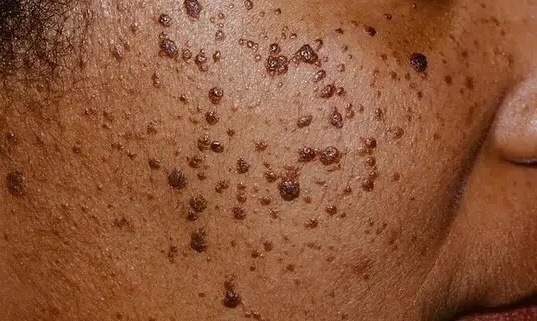
If you have small, dark raised spots on your face and have been wondering what they are- whether anything can be done- you are in the right place.
Over the past year, we have noticed a real shift in the questions our clients are asking at E&G Skin Clinic. Alongside enquiries about facials, chemical peels, and advanced skincare, more and more people are coming to us asking about those small, raised dark spots that tend to cluster on the cheeks, forehead, and around the eyes. Many people have lived with them for years, assuming nothing could be done. Others are only just learning that these spots even have a name.
They are called Dermatotis Papulosa Nigra – DPN for short – and the good news is that we remove them here at our Edinburgh Clinic
What Is Dermatosis Papulosa Nigra?
Dermatosis Papulosa Nigra is a completely benign ( non-cancerous) skin condition that appears as small, dark brown to black, raised papules- essentially tiny bumps- most commonly on the face, neck, and upper chest. They are harmless and cause no medical problems whatsoever, but many people find them aesthetically bothersome, particularly when they become numerous over time.
DPN is strongly associated with darker skin tones. Research suggests it affects between 35% and 77% of people with Fitzpatrick skin types IV- VI- that is, people of African, Caribbean, South Asian, East Asian, and Middle Eastern heritage. That said, DPN can and does appear across a wide range of ethnicities, so it is not exclusively a condition of darker skin.
The spots typically begin appearing in adolescence or early adulthood and tend to increase in number and size with age. They most commonly show up on the upper cheeks and temples but can spread to the neck, chest, and back over time. They do not hurt, they do not itch ( in most cases), and they carry absolutely no risk of becoming cancerous.
Worth knowing: DPN is often hereditary. If a parent or grandparent had these spots,, there is a strong chance you will develop them too. This is entirely normal and common- though we completely understand if you would prefer to have them removed.
What Causes DPN?
The exact cause of Dermatosis Papulosa Nigra is not fully understood, but it is believed to be a combination of genetic predisposition and sun exposure over time. They are not caused by a virus, bacteria, or any kind of infection. You cannot catch DPn, and it is not contagious.
Think of them as a variation is how certain skin cells develop, particularly the keratinocytes ( the cells that make up the outer layer of your skin). In DPN, these cells cluster and proliferate slightly differently, creating those distinctive small raised spots.
Because there is a hereditary element, if you are seeing more spots appear as you get older, that is entirely expected and does not indicate anything is wrong with your health.
How is DPN Different from Other Skin Lesions?
People sometimes confuse DPN with other skin conditions, including moles, seborrhoeic keratoses, syringomas, or even acne scarring. Here is a quick way to think about the differences:
- Moles are usually flat or only slightly raised and often appear in isolation. DPN tends to appear in clusters and is consistently very small.
- Seborrhoeic Keratoses can look similar but tend to be larger, waxier, and slightly rougher in texture, often appearing later in life
- Syringomas are small benign tumours of the sweat glands and tend to appear in clusters beneath the eyes- they look similar but are usually skin- coloured rather than dark.
A professional assessment at our clinic will always confirm whether what you are experiencing is DPN before any treatment is recommended. We never treat without being confident in what we are dealing with.
DPN Removal: How Do We Treat It at E&G?
There is no one-size-fits-all approach to DPN removal, and this is where having an experienced practitioner really matters- particularly when treating darker skin tones, which carry a higher risk of post- inflammatory hyperpigmentation (PIH) if the wrong technique or energy setting is used.
At E&G Skin Clinic in Edinburgh, we assess each client individually and discuss the most appropriate method based on the number of lesion, their location, your skin type, and your personal priorities. The methods typically used for DPN removal include:
.
Electrocautery ( Diathermy)
This is one of the most widely used and effective approaches for DPN removal. A small probe delivers a precise electrical current to the lesion, effectively destroying the tissue. It is quick, targeted, and – in experienced hands- leaves very minimal scarring. Recovery is typically straightforward, with small scabs forming and falling away in one to two weeks.
Cryotherapy
Liquid nitrogen is applied to freeze and destroy the tissue. It is effective for some lesions but is used with particular care on darker skin tones, as freezing can cause temporary or permanent lightening of the surrounding skin ( hypopigmentation). We will be upfront with you about whether this is appropriate in your case.
Curettage
A small curette ( a scoop- shaped instrument) is used to gently scrape away the lesion after the area has been numbed with a topical anaesthetic. This is a well- established technique for smaller, more superficial DPN Lesions.
Our Approach: We know that treating darker skin tones requires specialist knowledge and a conservative hand. Post- inflammatory hyperpigmentation is a real consideration, and we will always prioritise protecting the integrity and tone of your skin throughout treatment.
What to Expect During and After Treatment
DPN removal is typically is a very well-tolerated procedure. Here is a general idea of what the experience looks like:
- A topical numbing cream is applied before treatment to keep you comfortable throughout
- The Treatment itself is usually completed within 30 to 60 minutes, depending on the number of lesions being addressed.
- Small scrubs or clusters will form over the treated spots-these must be left to fall away naturally. Do not pick them.
- The skin beneath will be pink or slightly red for a short period while it heals.
- Sun protection is essential in the weeks following treatment. SPF every day, without fail.
- Temporary post-inflammatory hyperpigmentation can occur, particularly in darker skin tones, but this generally fades over weeks to months with the right aftercare.
- Most clients see the treated lesion resolve fully after one session, though some particularly raised or numerous spots may benefit from a follow-up treatment.
We will provide you with a full aftercare guide and will always be available for questions in the days following your appointment.
Is DPN Removal Right for You?
DPN removal is a personal decision. These spots are entirely harmless, and there is absolutely no medical requirement to have them treated. Some people wear them with complete confidence and have no interest in removal- and that is wonderful.
But for others, the spots cause real self-consciousness, particularly when they are numerous or situated in prominent areas of the face, and for makeup wearers, it takes away from the smooth Kanvas they try to have. If you find yourself avoiding certain photographs, applying makeup, or simply thinking about your skin more than you would like, that is a completely valid reason to explore treatment.
At E&G Skin Clinic, we never push treatments. Our consultations are a space for honest conversation — we will tell you exactly what we can achieve, give you a realistic expectation of results, and ultimately leave the decision entirely with you.
Why Choose E&G Skin Clinic in Edinburgh?
Edinburgh has no shortage of skin clinics, and we know you have options. Here is why clients choose us for DPN removal specifically:
- We have direct, hands-on experience treating DPN across all skin tones, including Fitzpatrick types IV, V and VI — skin types that demand extra care and specialist knowledge.
- We take time during consultations. We will not rush you through an assessment.
- We are honest about what we can and cannot achieve. If a treatment is not suitable for you, we will tell you that clearly rather than proceeding anyway.
- We are based centrally in Edinburgh, easy to reach from across the city and the Lothians.
- We follow up. Our relationship with clients does not end when you walk out the door after treatment.
Frequently Asked Questions About DPN Removal
Is DPN removal painful?
Most clients describe the treatment as mildly uncomfortable rather than painful. We apply a topical anaesthetic cream before the procedure, which significantly reduces any sensation during treatment.
Will the spots come back after removal?
Treated lesions do not typically return. However, because DPN has a genetic component, new spots can develop in other areas over time — this is simply the nature of the condition rather than a failure of treatment.
How many sessions will I need?
The majority of clients achieve excellent results in a single session. If you have a very large number of lesions, or some that are particularly raised, we may recommend splitting the treatment across two appointments to allow the skin adequate healing time.
Is DPN removal safe for darker skin tones?
Yes — when performed by an experienced practitioner who understands the specific considerations for darker skin. The main risk to be aware of is post-inflammatory hyperpigmentation, which is why technique, settings, and aftercare all matter enormously. We have specific experience treating darker skin tones safely.
How much does DPN removal cost in Edinburgh?
Pricing at E&G Skin Clinic is based on the number of lesions being treated and the method used. We provide a full price breakdown during your consultation so there are no surprises. Please get in touch to arrange a consultation, and we can discuss costs openly.
Can I wear makeup after DPN removal?
We recommend avoiding makeup on the treated areas for at least 48–72 hours to reduce any risk of irritation or infection while the skin is healing. We will give you specific guidance on this as part of your aftercare instructions.